Wednesday, 19 October 2011
Things we forgot to mention - Tarantula!
Got your attention didn't I?
We'd encountered a family of boys, gabbling excitedly about the tarantula they'd
spotted not far from the rim of the Grand Canyon. 'Do you think you can find it
again for me?' I asked. 'Sure' they shouted. And after a 2 minute search it sprang
out from the grass right in front of me. I hasten to add it's not poisonous. Sorry
no one volunteered finger to provide a sense of scale for the picture. Suffice to
say it was big!
What else did I pass over.
Ok, so back at Albuquerque, before the balloons rose over the city, we rose over the valley, not in a balloon, but up to the top of the Sandia Peaks which overlook the city. The elevation was just over ten thousand feet - almost two miles high.
Then we drove the Turquoise trail to Santa Fe! A gorgeous inner city surrounded
by big surburbs. But even the suburbs mimic the pink adobe architecture that
dominates the scenery:
Something else we neglected to describe was another excursion in Tucson:
our hosts took us up to Kitt Peak - a mountain top that features the 'most
diverse collection of astronomical observatories on earth.' Tucson actually
has a system of low level street lighting to facilitate the folks at the
observatory.
So, after a day of cruising down Mt Lemon and driving up Kitt Peak with a stop
at San Francisco Chapel, what could be more appropriate than driving through
old Tucson in search of a Margerita!? And Old Tucson - old buildings recently
renovated - is lovely.
Cactus and Palm trees. Warm summer breezes, even in October! Very
seductive! Oh, and the Margaritas pack a punch!
So I've already mentioned the tarantula.
and the chocolate taco
at the Grand Canyon.
I've already filled you in on the attractions of Page Arizona, and Monument Valley.
At Durango, we decided to make tracks for Chicago, which meant we'd miss the
spectacular mountain scenery in Colorado, going north to Silverton and Ouray. So we
only got the second rate scenery going west to Kansas! And check out the snow in them thair mountains...second rate or otherwise!
At the end of a long day, a week ago, the full moon guided us in to Colby Kansas.
More from Chicago, next!
Sunday, 16 October 2011
Monument Valley Arizona
We left Page, AZ, On Monday, October 10th. We are now heading east.
My hope is that on this day we will travel through Monument Valley, stop at the
4 Corners (to be explained later) and visit Mesa Verde before crashing in
Durango, Colorado. That was my hope.
Blair has a favourite spot on the way to Peggy's Cove. It's a point where there
are two 30 foot boulders - one on each side of the road - perfect spots for
an ambush by movie outlaws or indians. As we drive by, he still fires his
six-gun first in one direction and then in the other.
You can imagine how he felt as we drove through this incredible place - the
vast set for innumerable Hollywood movies - most famously Stagecoach starring
John Wayne as Johnny Ringo! Awesome!
The geologists report that the buttes and spires are all that remain of a wide
sandstone plane that's been worn down by the action of ancient rivers and
current storms. Perhaps in another millenia or more, these monuments, too,
will be gone.
We were warned by signs not to leave the road unless in the company of a
Navaho guide. I would have loved to have done this. Why do we restrict our
time when we have no deadlines? I think that we both are starting to feel
a bit dazed by the geography and the distances...and a desire to find home again.
So we kept going to the Four Corners: It too is on the Navaho reservation, although
they must get a real kick out of the visitors like us who come to observe the totally
arbitrary point where four states come together. Of course it doesn't stop them
from offering a wide variety of kitch for sale, mixed in with good hand-crafted
silver and turquoise.
We both wanted to see the spot. And here it is: Utah, Arizona, Colorado and New Mexico!
Blair agreed to have his picture taken with a limb in each state, but with one proviso:
He says he found a way to answer the question put by the Firesign Theater's "How can you be in two places at once when you're not anywhere at all!?'
http://en.wikipedia.org/wiki/How_Can_You_Be_in_Two_Places_at_Once_When_You're_Not_Anywhere_at_All
By doing this he doubled the ante!
He really is a great sport. By the way he's the one taking most of the pictures so
far. I obviously didn't stop to figure out how to eliminate my shadow from the
picture.
But the shadow gives you an idea that the day is coming to an end...and we still had
three hours of driving to hit Durango. So we had to by-pass Mesa Verde... it's the
archaeological site of the Hopi Cliff dwellers of the area...
But there are so many places to revisit...We are determined to return. On to Durango,
Kansas and Chicago. Farewell to the Southwest. We'll be back!
Friday, 14 October 2011
Recalling a Garden of Hope
(I couldn't resist my journalistic roots when I stumbled on this story right under my nose, during our visit to St. Louis. That was two weeks ago. Take heart. I did.)
On
the edge of downtown St. Louis, across from the regional offices of the FBI and
in the shadow of a busy hotel, hope has taken root along with a field of garden
vegetables that form the City Seeds Urban Farm.
There are thousands of community and rooftop gardens springing up across the country, some with government help. But this one in Missouri is unique. The organizers are driven by a commitment to produce organic, local produce and at the same time teach the basics of market gardening to a very special group of helpers.
Depending
on the day of the week, the staff and volunteers at City Seeds Urban Farm could
be working with clients of the social services system - men and women of all
ages who are homeless or addicted to drugs or newly released from prison. At other times the helpers are military veterans,
desperate to find work and avoid homelessness themselves.
Off
to one side of the farm are separate patches:
small
garden plots with the names of their owners written long-hand on pieces of paper.
One of them - with young shoots of radishes and beets - belongs to Alice Burgdorf - an intense bundle of energy, who speaks in short bursts of painful openness.
As a visiting journalist, I asked for a
volunteer amongst the clients - someone who would agree to an interview. Alice's hand went up like a shot.
When
I interviewed her in late September, she was homeless - sleeping at St.
Patrick's shelter in St. Louis. She'd
been part of the City Seeds program for three weeks. But in the time her tiny garden on the edge
of the farm showed some healthy sprouts of radishes and beets. "I've
been part of the DFS since I was six...that's the Division of Family Services...I
was in foster homes until I was 18."
She tells a story that's all too common - of bouncing around from one foster home to another - falling into drug addiction - and finally homelessness. But at the age of 45 she's convinced her caseworkers at St. Patrick's that she can learn enough from working at the farm to make a difference.
"What I like about this place is that nobody's yelling at you. It's so peaceful!'
What makes this project unique is that it's a blend of agricultural pragmatism, Roman Catholic spirituality and fundraising prowess. Add to that the lessons first learned
at Alcoholics Anonymous. Just ask volunteer councillor, 22 year old Brianna McGuire.
She's a member of the Jesuit Volunteer Corps - a faith based organization that supports volunteers like her. The JVC works with the St. Patrick Centre. It is the largest non-profit organization in St. Louis that provides assistance to the homeless.
Brianna receives $100 a month for her expenses at a house she shares with other volunteers. For that, she devotes most of her time to City Seeds. She's on the lookout for value-added projects - like making candles from the wax provided by the farm's bee hives; or producing vinegars flavoured with the fragile herbs grown on the urban hillside. She shows clients how to press flowers for greeting cards.
But she devotes equal attention to the clients themselves. As a trusted volunteer she studies the clients files and their personal histories. "Here at the garden I try to keep
them on track, keep them focussed on the garden. I like to call it horticultural therapy."
They've even developed their own 12 step program. I don't have them all, but Brianna explains the 12 steps are divided into three groups: one involves the neeed for pruning
and thinning in your personal life, the same as in a garden.
Another involves the need for patience - truly necessary in farming and in human relationships.
Another involves, she says, the need for honest interaction: 'You have to be consistent with crops...you can't pretend to water a plant. If you don't look after it properly, you'll see the consequences.
Brianna admits that some of the metaphor breaks down: how can you ask forgiveness from a plant?
The clients are not expected to buy into the Catholicism...but they are expected to make an effort with the 12 steps.
She explains the whole thing started in 2006 with a $US210,000 grant from the US Department of Agriculture focussed on food security. Since that was exhausted in
2010 the small staff spend much of their winter raising money from every possible source.
Last year they produced 11,000 pounds of produce. Some is sold at the St. Louis farmers market and some of it is given to people.
As a Peace Corps alumnus, she says, "I was drawn to this work."
She says there are several measurements of success with the clients. "For the vets...we aim for employment after the ten week program. For the homeless, we hope they will find their own homes after a 16 week program. And for those dealing with substance abuse, we hope they can find a way to live cleanly.'
As for Alice Burgdorf, she has an apartment lined up beginning in October. In the meantime, she's tending her beets and radishes with a tenderness that only new
gardeners can understand.
Thursday, 13 October 2011
Page Arizona
Page is in the northwest corner of Arizona. It's surrounded by the Navaho Nation Lands - anyone who's read Tony Hillerman's Jim Chee mysteries willhave a good image in their mind's eye of the geography. Vast and dry and old. Endless horizon, cloudless blue skies.
Page is a town of nine thousand people that's visited by 5 million people annually. Many are on their way through to the Grand Canyon in one direction or to Bryce and Zion Canyon's national parks in the other. The town was set up in 1957 as a land swap with the Navaho. It would be the home for the thousands of workers who came to build and operate the massive Glenn Canyon Dam across the Colorado River. Blair had to take a deep breath to overcome his vertigo in order to take this shot.
The reservoir is called Lake Powell and has become a recreation site for swimmers, boaters, divers - a bizarre lakeshore with no trees...overshadowed by buttes and mountains.
It was finished in 1966 and amidst great controversy flooded the gorge and
canyons behind it.
We had a busy time while we were there, but took some time out for lunch at Big John's Texas Barbecue. Blair and I love barbecued pulled pork...so wanted
to find out how a Texas Barbecue joint was set up here in Page in NW Arizona.
John Crim is standing beside his big barbecue pit where he's about to barbecue
200 pounds of pork and 220 pounds of beef brisket. He's a retired mechanical
engineer who pursued his love of 'barbecue' with a mobile rig he used to tour
the barbecue circuit throughout the southwest. He was based in Flagstaff
but decided to try opening his first restaurant in Page. Turns out
he's a route 66 fan and even though Page is about 200 kms north of 'The Mother Road"
he thinks he'll draw many of the same type of customers...like us!
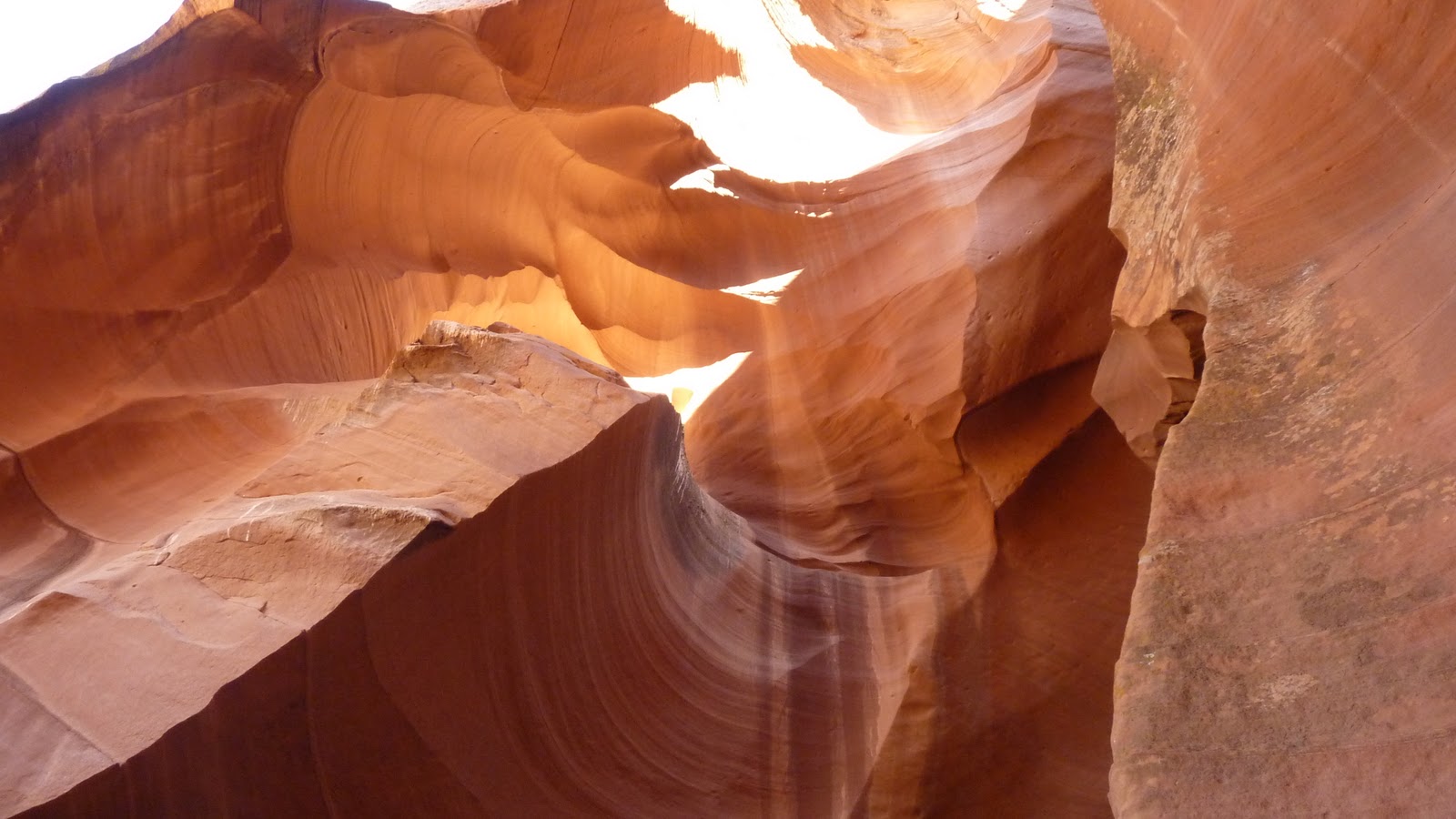
The main reason we were there, though was to visit something geologists call a slot canyon - a narrow canyon formed by rushing water through sandstone or limestone.
The Navaho have called it Antelope Canyon. And since it's on Navaho land, they control access to it. For a fee of $32 they drive you out of Page into a dry, sandy wash that ends at a cliff face with what looks like a cave opening slashed into it.
It's hard to believe that there's ever enough water in this desert to carve the natural
sculptures we saw inside. But at times the canyon is flooded with swift
flowing water more than half its depth. The pictures you'll see are shot mainly
with the camera pointed upward to the light gleaming in from the top. But the
camera's also pointed up to avoid the heads of all the people who do the tour.
It's a zoo! Our Navaho guides move groups in and out of the quarter
mile canyon with wry amusement. But despite the congestion, we were
awed by the beauty.
Next - Monument Canyon on our way to Durango Colorado. Get out your cowboy
Page is a town of nine thousand people that's visited by 5 million people annually. Many are on their way through to the Grand Canyon in one direction or to Bryce and Zion Canyon's national parks in the other. The town was set up in 1957 as a land swap with the Navaho. It would be the home for the thousands of workers who came to build and operate the massive Glenn Canyon Dam across the Colorado River. Blair had to take a deep breath to overcome his vertigo in order to take this shot.
The reservoir is called Lake Powell and has become a recreation site for swimmers, boaters, divers - a bizarre lakeshore with no trees...overshadowed by buttes and mountains.
It was finished in 1966 and amidst great controversy flooded the gorge and
canyons behind it.
We had a busy time while we were there, but took some time out for lunch at Big John's Texas Barbecue. Blair and I love barbecued pulled pork...so wanted
to find out how a Texas Barbecue joint was set up here in Page in NW Arizona.
John Crim is standing beside his big barbecue pit where he's about to barbecue
200 pounds of pork and 220 pounds of beef brisket. He's a retired mechanical
engineer who pursued his love of 'barbecue' with a mobile rig he used to tour
the barbecue circuit throughout the southwest. He was based in Flagstaff
but decided to try opening his first restaurant in Page. Turns out
he's a route 66 fan and even though Page is about 200 kms north of 'The Mother Road"
he thinks he'll draw many of the same type of customers...like us!
The main reason we were there, though was to visit something geologists call a slot canyon - a narrow canyon formed by rushing water through sandstone or limestone.
The Navaho have called it Antelope Canyon. And since it's on Navaho land, they control access to it. For a fee of $32 they drive you out of Page into a dry, sandy wash that ends at a cliff face with what looks like a cave opening slashed into it.
It's hard to believe that there's ever enough water in this desert to carve the natural
sculptures we saw inside. But at times the canyon is flooded with swift
flowing water more than half its depth. The pictures you'll see are shot mainly
with the camera pointed upward to the light gleaming in from the top. But the
camera's also pointed up to avoid the heads of all the people who do the tour.
It's a zoo! Our Navaho guides move groups in and out of the quarter
mile canyon with wry amusement. But despite the congestion, we were
awed by the beauty.
All of these were shot with natural light...no flash... exposure pushed a bit.
Photography has been so important on this trip. I would never be able to remember
the curves and lines of Antelope Canyon without it. We've seen so much
beauty - the balloons at Albuquerque; the desert around Tucson; the Grand Canyon.
Next - Monument Canyon on our way to Durango Colorado. Get out your cowboy
hats and lariats!
Subscribe to:
Posts (Atom)